

Is CGI Collapsing? AI vs 3D Modeling and Archviz



Not long ago, getting a nice interior image meant going the whole way: build the model, place the furniture, set up materials and lighting. Then wait for the render and spend some more time in Photoshop. These days, a photo of an empty room or a simple sketch plus a couple of sentences in a chat is often enough. And at first glance, the result looks a lot like a visualizer’s work.
Which brings up the question hanging over everyone who makes a living in 3D: is the CGI industry just changing, or is it actually collapsing? I tried to figure out what AI can already do in modeling and visualization, what 3D artists themselves say about it, and where I think all of this is heading. Especially in archviz, because it looks like it’ll get hit first.
What AI Can Already Do Without a 3D Package
Rendering Right in the Chat
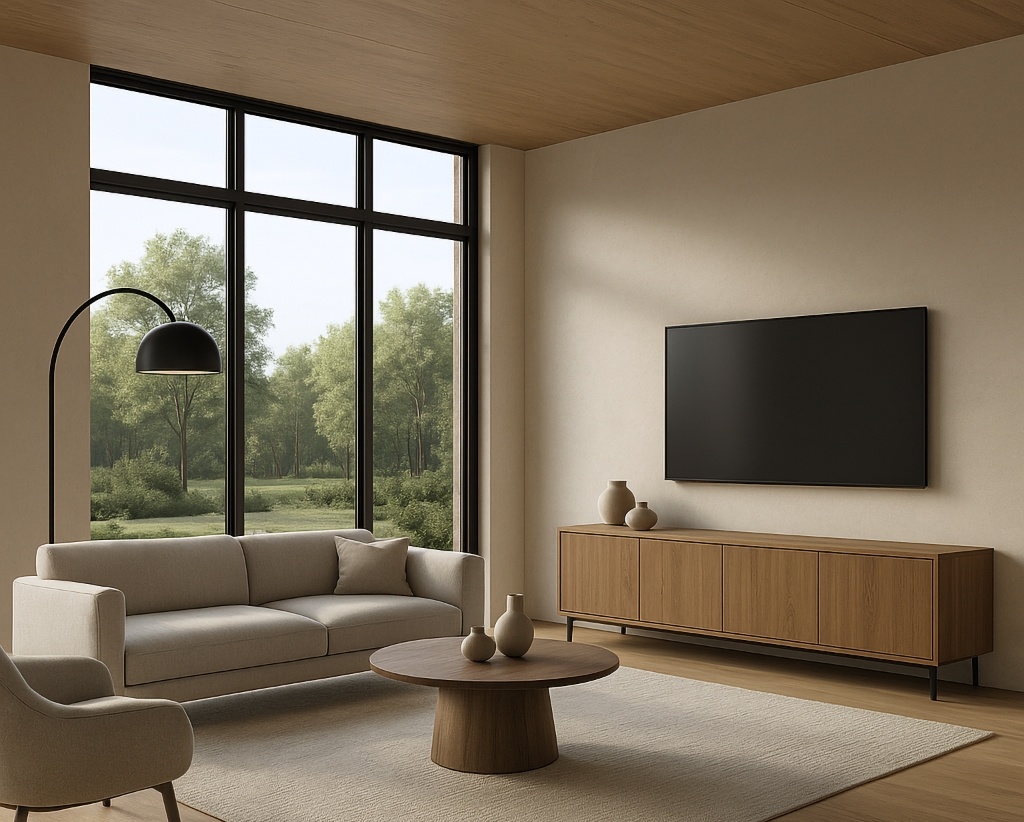
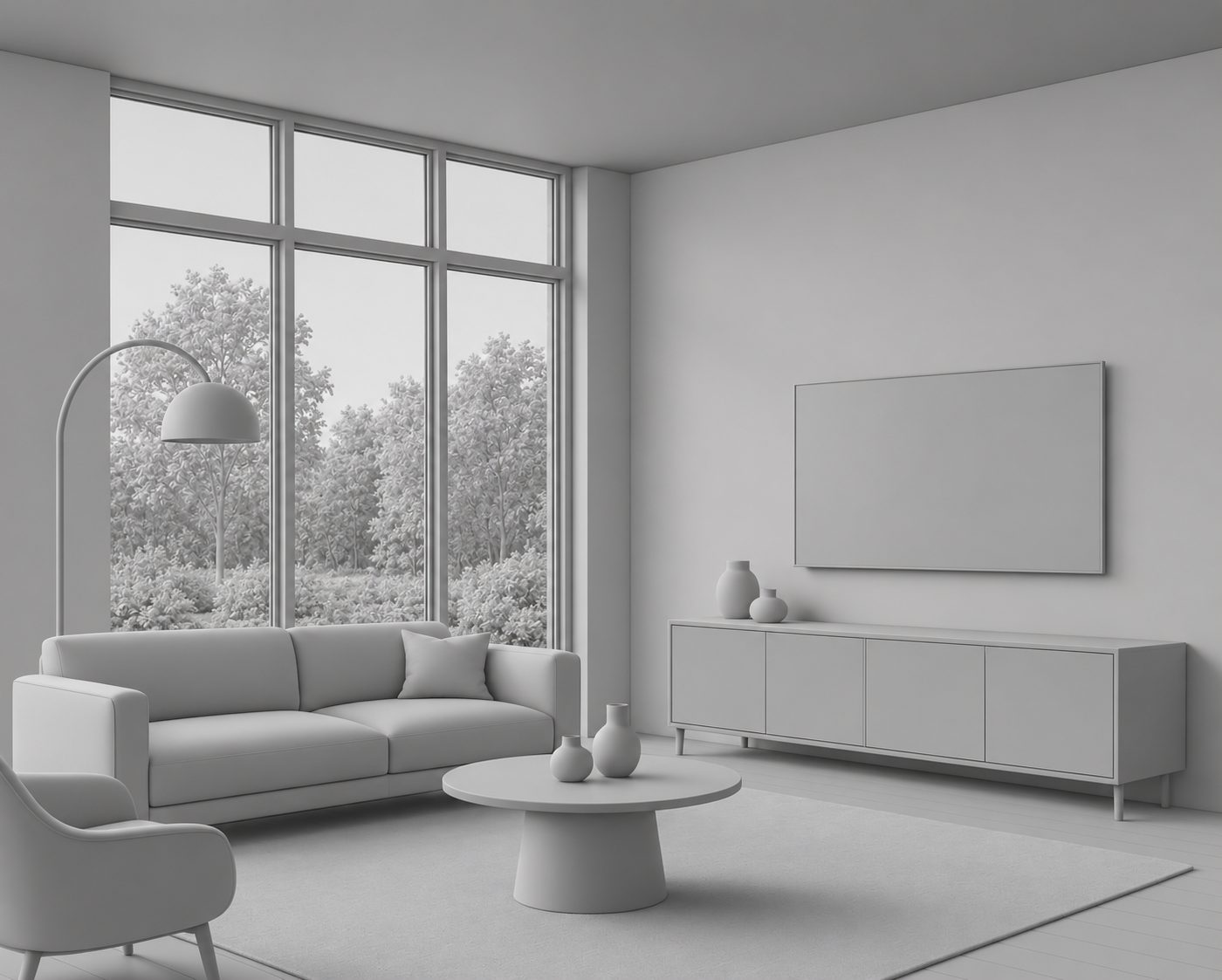
The most visible change happened with images. Midjourney, Stable Diffusion with ControlNet, the image generators inside ChatGPT, and Nano Banana can take a sketch, a photo of an empty room or a rough clay render and turn it into a finished visualization. You can ask them to change the style, the floor material or the time of day, or to add furniture. All in plain words, without touching a single setting in 3ds Max or Corona.
And these aren’t toys for enthusiasts anymore. Render engine developers are pulling AI into their own products: for example, Chaos bought EvolveLAB, the makers of Veras, a plugin that generates rendering variations on top of a 3D model. When the company behind V-Ray and Corona invests in neural networks, that’s a pretty good sign of which way the wind is blowing.
Modeling: A 3D Model From a Picture
Modeling is a similar story, just a bit slower. Services like Meshy, Tripo, Rodin or Tencent’s Hunyuan3D build a 3D model from a single photo or a text description. A chair, a vase, a decorative trinket, a game character: upload a picture, get a textured mesh. For things like that, modeling from scratch is no longer a must.
Is it perfect? No. The mesh is often messy, the topology is chaotic, you’d better not look at the UVs, and nobody guarantees accurate dimensions. But for background objects that take up a couple hundred pixels in the frame, it’s often good enough already. And those are exactly the models a lot of people have been making money on for years: stock assets, custom models for visualizers, scene filler.
Video and Animation
Video deserves a separate mention. Sora, Veo, Kling and Runway generate clips from text or a single image. A camera flythrough of an interior that used to require animation, rendering hundreds of frames and editing can now be pulled out of one frame. Still with artifacts and without precise control, but the direction is clear.
Why Archviz Is About to Take the Hit
Architectural visualization is, in my view, the most vulnerable part of CGI. And it’s not because archviz artists are worse than anyone else. Most of this market is just very simple: a designer or a developer needs a beautiful image to sell an idea. Not an engineering-accurate one, but a beautiful and convincing one. And beautiful, convincing images are exactly what neural networks are best at.
Take a typical job: an apartment interior, several camera angles, a couple of revision rounds. Not long ago you couldn’t do it without a visualizer. Now a designer can sketch out options in a chat, show the client the style and mood, and come to a visualizer only for the final images. Or not come at all if the client already likes what they see.
So what goes first isn’t all the work, but its most mass-market and cheapest part: concepts, style options, quick images for social media and listings, standard interiors. And that’s exactly what a huge share of freelancers relied on.
What 3D Artists Themselves Say
People argue about this everywhere, from Reddit to niche forums and chats, and the same arguments keep coming up. Simplifying a bit, you can split people into a few camps:
- Panickers. “We’ll all be replaced soon, retrain while you still can.” Their main argument: clients already bring AI images saying “make it like this, only cheaper.”
- Skeptics. “AI can’t hold dimensions, can’t handle revisions properly and won’t show the same sofa from another angle. A serious client won’t accept that.” Fair points in many ways, but they describe AI as it is today.
- Pragmatists. These folks have already built AI into their work: they generate concepts, touch up and upscale images, and still build the main scene in 3D as before. Their position is simple: it’s a tool, and whoever learns to use it wins.
- Artists. This group talks not about money but about meaning. If you can get an image with a single sentence, where’s the craft? And who owns the result if the model was trained on other people’s work?
The funny thing is, everyone is right in their own way. Panickers and skeptics are looking at the same picture, just from different sides: one group sees how fast everything is changing, the other sees what still doesn’t work.

Where AI Still Stumbles
To avoid sliding into pure panic, it’s worth taking an honest look at the weak spots. There are still plenty:
- Accuracy. The neural network doesn’t know that the opening is 900 mm wide, or that the sofa is a specific model from a specific manufacturer. It draws “something similar.”
- Revisions. The classic request “move the wardrobe 20 centimeters to the left and change only the handles” often turns into a lottery for a neural network: half the image changes along with the wardrobe.
- Consistency. The same interior from five angles, with matching furniture, materials and lighting in every shot, is still a real pain.
- Animation and interactivity. A long, stable flythrough, a VR tour or an apartment configurator for a developer still needs a real 3D scene.
- Responsibility. If the window in the image ends up somewhere other than where it is in the project, who’s to blame? Developers sell apartments based on these renders, so for them it’s no small thing.
But there’s an important “but.” Almost every item on this list comes with a “for now.” A lot of things people were laughing at not long ago, neural networks have already learned to do properly. So I definitely wouldn’t build a career on the idea that AI can’t do something.
My Take: What Collapses and What Stays
Now for what I actually think. Yes, the CGI industry as it is today will collapse, and fairly soon. But it’s not the whole profession that collapses, it’s the model where the client pays for hours spent on modeling and rendering.
What Goes First
The mass market. Standard interiors, concepts, images for listings and social media, simple objects, stock models. Here AI is already faster and cheaper, and the quality is good enough for these jobs. Prices in this segment will keep dropping, there will be fewer orders per person, and those who made a living only from this will have a very hard time.
What Stays
Work where accuracy and control matter. Developers with real projects, furniture manufacturers with their own catalogs, architects who need to show their actual building, not “something similar.” Plus animation, VR, interactive and real-time. There the 3D scene will remain the foundation for a long time, just with more and more AI around it.
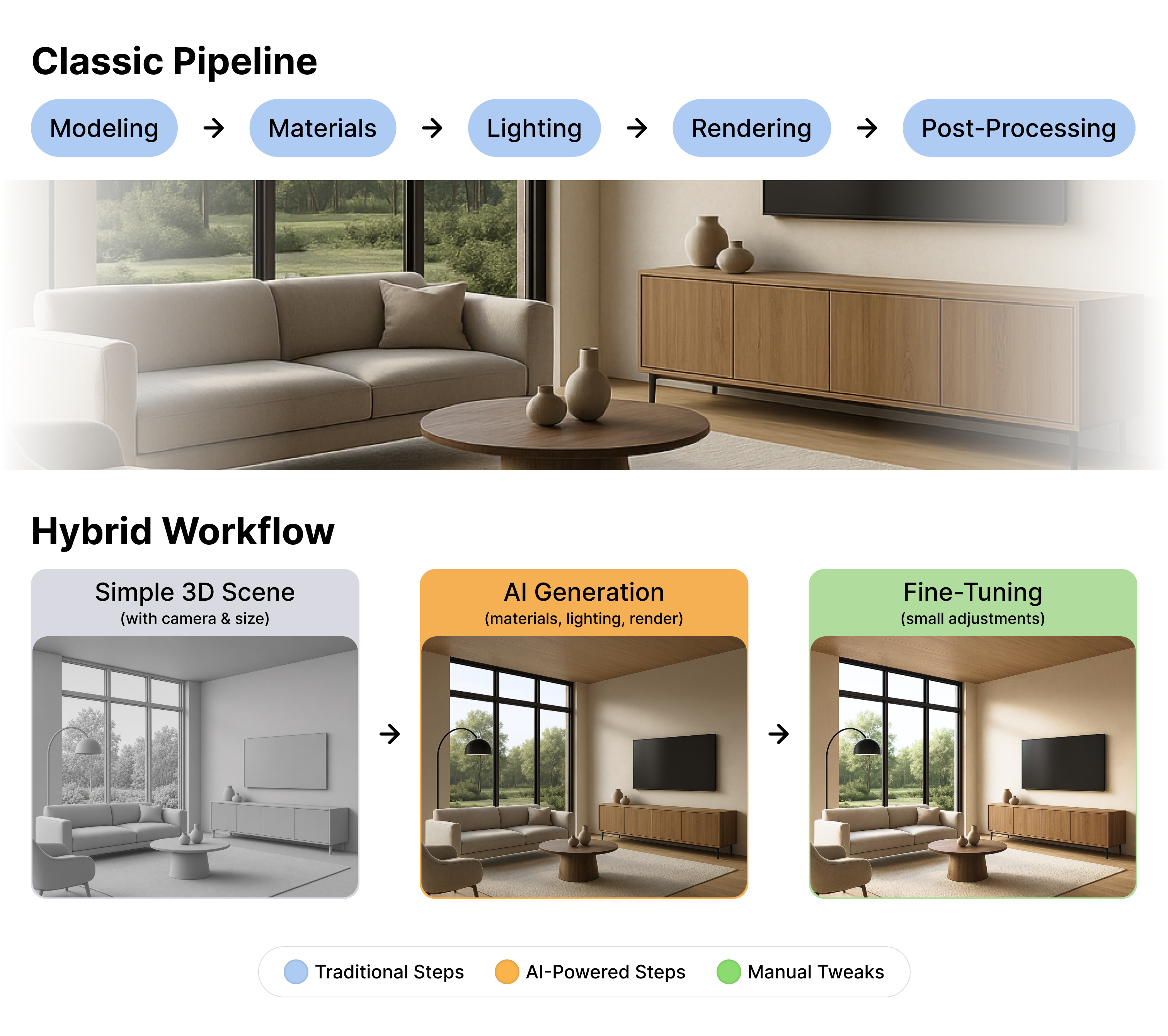
And here’s the key point, as I see it. The 3D scene most likely won’t disappear, it’ll turn into a framework for AI. You build the geometry, camera, dimensions and layout, meaning everything that has to be accurate. The neural network takes over what used to eat up tons of time: materials, lighting, set dressing, atmosphere. A hybrid like this gives you the control of 3D and the speed of AI at the same time.
What the Visualizer Becomes
It seems to me the visualizer of the future is no longer “the person who knows Corona really well,” but more of an image director. Someone who understands composition, light, architecture and the client’s taste, knows how to steer neural networks, and knows when you need 3D and when a prompt is enough. Technical skills lose value the fastest. A trained eye, taste and an understanding of the client’s task lose value the slowest.
And even the part of the work that stays inside 3ds Max will be done by hand less and less. AI agents are already being connected to 3D packages, handling routine tasks from a text command. So it’s not just the result that’s changing, but the process itself.
So, Should You Panic?
Short answer: it’s too late to panic, and dangerous to ignore. The CGI industry really is collapsing, at least the part where people sold hours of work in a 3D package. The image itself is getting cheaper before our eyes, and there’s no stopping it.
But people still need a result that someone is accountable for: accurate, consistent and made for a specific task. Those who learn to work with AI rather than against it will most likely come out ahead: every job can be done faster, and you can take on more projects. And those who wait for things to go back to how they were risk simply running out of clients.
What do you think? Are you already using AI in your work, or do your clients still want things “the old way”? Let me know, I’m curious to compare.
FAQ
1. Can you already get an interior visualization without a 3D package?
2. How good are the 3D models AI makes from a picture?
3. Why is archviz considered the most vulnerable part of CGI?
4. What does AI still struggle with in visualization?
5. So will the CGI industry collapse or not?
6. What will the visualizer's role look like in the future?
Latest articles


{{comment.text}}