

3Ds Max mirroring problem



Very often, even not only beginners make the same mistake when using the standard Mirror tool.
If you use the standard Mirror tool from the Main Toolbar, when mirroring objects, all polygons of the new object become "Flipped ".
This cannot be seen in the Viewport until you do Reset XForm and enable Backface Cull in the object properties and enable the Clay display mode (it all depends on the Viewport settings, but it is better to use the Clay mode).

Flipped polygons can give bad results when rendering, when using such a model in game engines they will have incorrect display, and according to the rules of good form, you need to make the model neat so that your teammates or those who will use your model further - did not do unnecessary work.
Why Flipping of polygons occurs when Mirror
The standard Mirror tool is very easy to implement. Under the hood, it does simple things that you can even repeat yourself.
Try creating a Teapot object in a blank scene, change the Z-axis Scale value from 100.0 to -100.0. A scale value with a minus value mirrors the object along a specific axis. It seems like everything is ingeniously simple, but after such actions your polygons will also be flipped out.
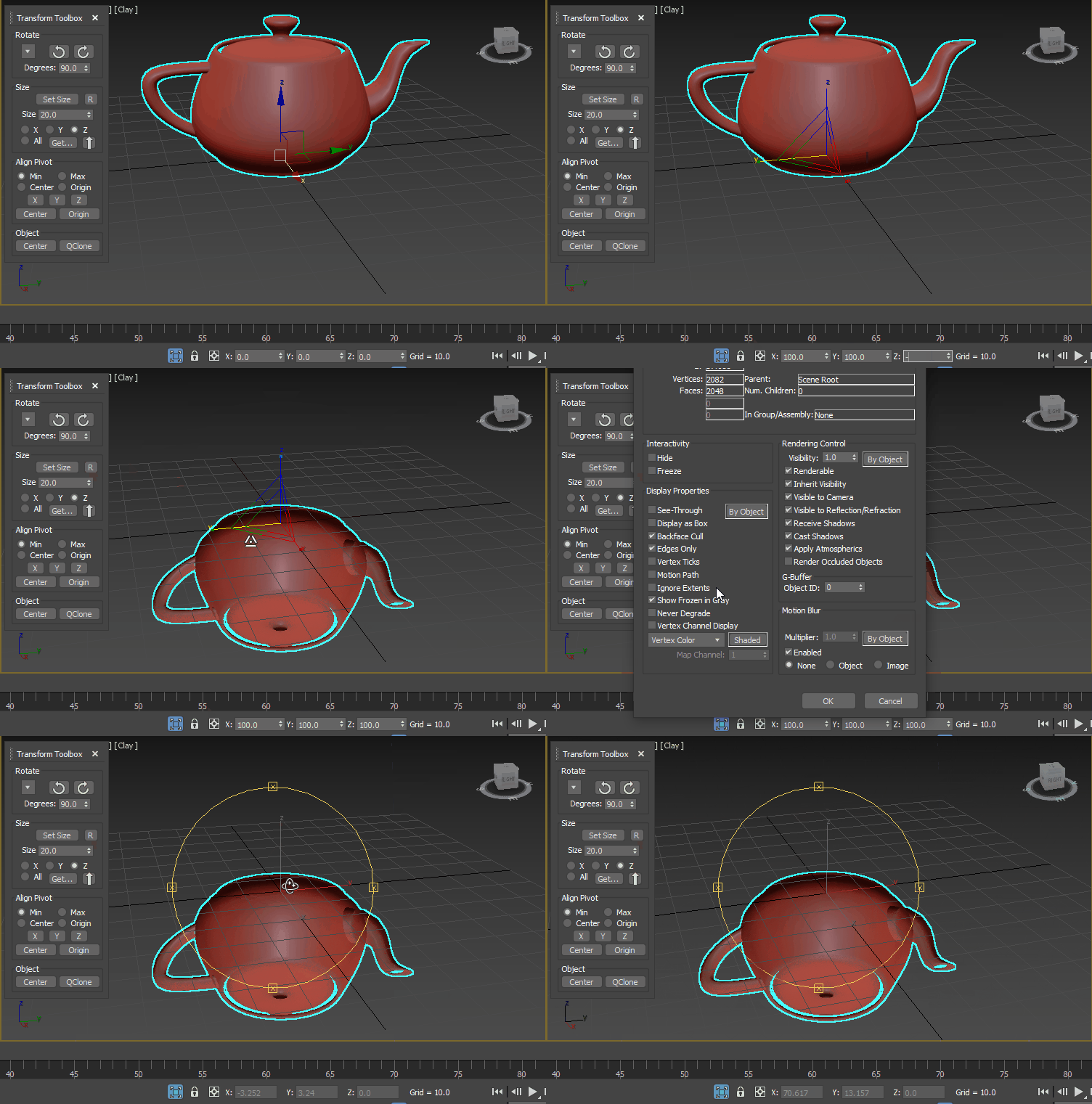
Therefore, the use of Mirror is highly discouraged by professionals when modeling in 3Ds Max. There are other ways to make Mirror, which we'll talk about below.
How to avoid Flipping or other Mirror ways
Method 1:
Using the Symmetry modifier.
Great option, especially if objects need one Mesh. If the objects need to be different Mesh, then you will have to Detach them.
Method 2:
Using the Mirror modifier.
The advantage is that the settings are as similar as possible to the regular Mirror tool. But the objects also remain one Mesh.
Method 3:
Use the same standard Mirror from the Main Toolbar, but then apply Reset XForm to the new object, and then manually flip all polygons.
Conclusion
Which way to use is up to you. I most often use the Symmetry modifier, because it suits my tasks best.
And for third-party models (for example, from stocks), I always do Reset XForm, my script always helps me with this Stock Model Fixer .
It can also help fix broken geometry with Snapshot, Detach Trick and Box Trick tools, and reveal problems with the model using the tools in the Check tab.
What methods do you use? Do you pay attention to Flipped polygons in your work?
Write in the comments, it will be interesting to know!
FAQ
1. What is this article about?
2. What is the most common mirroring mistake in 3ds Max?
3. Why do flipped polygons appear after mirroring?
4. Why are flipped polygons a problem?
5. Can flipped polygons always be seen in the viewport?
6. What is negative scaling?
7. Why do professionals often avoid the standard Mirror tool?
8. What is the recommended alternative to the Mirror tool?
9. What are the advantages of the Symmetry modifier?
10. Can the Mirror modifier be used instead?
11. Does mirroring affect UV mapping?
12. Can mirroring cause problems when exporting models?
13. Is Reset XForm useful after mirroring?
14. Can mirroring affect animation and rigging?
15. How can mirroring problems be prevented?
16. Who is this article useful for?
Latest articles


{{comment.text}}